Introduction: The Illusion of Passivity
Walk into any networking event, boardroom, or crowded dinner party, and your attention will naturally gravitate toward the loudest voices. Society conditions us to equate talking with contributing and silence with absence. But if you take a moment to look past the charismatic storytellers and the extroverted leaders, you will find the silent person in the corner.
To the untrained eye, they seem disengaged or shy. But psychology tells a entirely different story. That silent person isn’t checked out; they are plugged in. They are actively gathering data, analyzing group dynamics, and processing information at a rate that would overwhelm the average extrovert.
Welcome to TheMindArchiveHQ. Today, we are exploring the fascinating psychology and neuroscience behind why quiet people are often the most observant, perceptive, and socially intelligent individuals in the room.
The Neuroscience of the Quiet Brain
To understand why silent people observe so much, we have to look inside the brain. Research pioneered by Dr. Marti Olsen Laney, a leading psychotherapist and author, reveals that extroverts and introverts rely on entirely different neurotransmitter pathways.
Extroverts are fueled by the dopamine pathway—a short, fast circuit that rewards external stimulation, quick talking, and risk-taking. Introverts, however, rely heavily on the acetylcholine pathway. Acetylcholine is linked to deep thought, memory, and intense focus.
Because the introvert’s neural pathway is longer and more complex, information travels through regions of the brain associated with remembering past events, planning for the future, and solving problems. When a quiet person is observing a room, their brain is literally cross-referencing everything they see with everything they know. They aren’t just watching; they are computing.
Active Listening vs. Waiting to Speak
There is a famous psychological adage: Most people do not listen with the intent to understand; they listen with the intent to reply. In a fast-paced conversation, the average person is spending their mental energy formulating their next sentence. They are waiting for a gap in the dialogue to jump in. Because their cognitive load is focused inward (on their own impending speech), they miss crucial external cues.
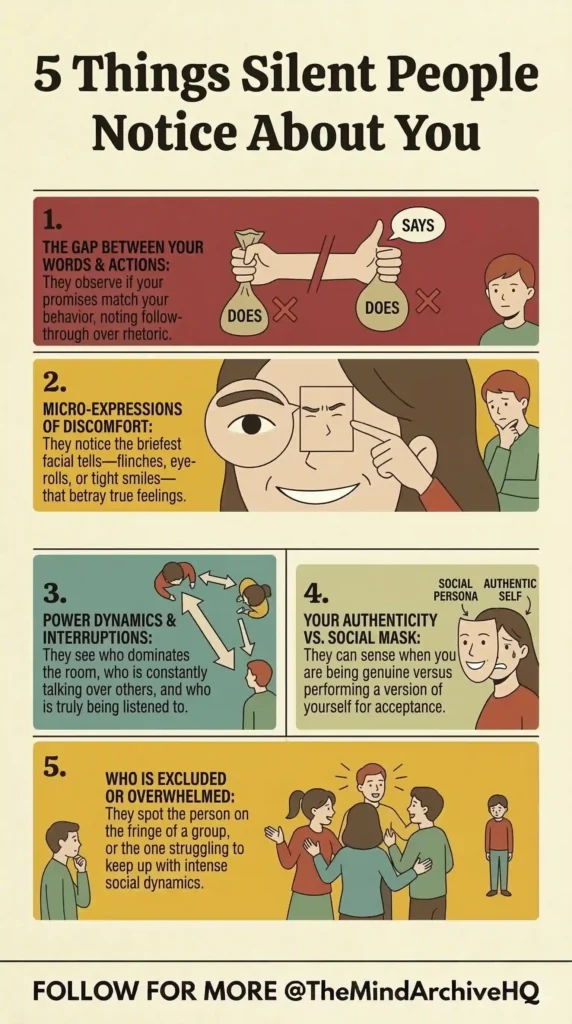
Silent people flip this dynamic. Because they feel no internal pressure to dominate the conversation, 100% of their cognitive bandwidth is dedicated to active listening. They hear the slight hesitation in a colleague’s voice. They notice when someone uses defensive language. They pick up on the emotional subtext—the how of what is being said, rather than just the what.
Masters of Micro-expressions and Body Language
Communication experts widely agree that non-verbal cues make up the vast majority of human communication. While the loud talkers are focused on words, the silent observers are reading the real story told by the body.
Because quiet individuals are not distracted by managing their own performance in a social setting, they become hyper-aware of micro-expressions. These are involuntary facial expressions that flash across a person’s face for a fraction of a second, revealing their true emotions before they have a chance to conceal them.
A silent observer will notice the quick flash of annoyance in a boss’s eyes, the shifting of a nervous person’s feet, or the difference between a polite, fake smile and a genuine “Duchenne” smile (which reaches the eyes). This makes them incredibly difficult to lie to or manipulate.
The “Fly on the Wall” Advantage
There is a unique sociological phenomenon that occurs around quiet people: others lower their defenses.
When you are loud and boisterous, people subconsciously perceive you as a social competitor. They put up their guard and carefully manage their own image around you. But a silent person poses no immediate threat to the ego. They act as a blank canvas.
Because of this, people are far more likely to let their true colors show around a quiet observer. They gossip, they complain, and they reveal their insecurities, entirely forgetting that the silent person is mentally logging every detail. By removing themselves from the spotlight, quiet people get a front-row seat to the unfiltered truth of human behavior.
High Environmental Sensitivity (The HSP Connection)
Many silent individuals fall into the psychological category of Highly Sensitive Persons (HSPs), a term coined by psychologist Dr. Elaine Aron. Being an HSP means having a central nervous system that is exceptionally tuned to environmental stimuli.
A highly observant quiet person doesn’t just notice people; they notice the entire ecosystem of a room. They sense the shift in atmospheric tension when a specific person walks in. They notice the flickering lightbulb, the subtle change in the background music, and the physical distance people are keeping from one another. This hypersensitivity means they absorb a massive amount of contextual data, allowing them to accurately “read the room” long before anyone else has figured out the vibe.
The Strategic Power of the “Signal-to-Noise Ratio”
In audio engineering, the “signal-to-noise ratio” compares the level of a desired signal to the level of background noise. The same applies to human communication.
People who talk constantly produce a lot of “noise.” Their words eventually lose value because they are so abundant. Silent people, however, produce pure “signal.” Because they speak rarely, they carefully curate their thoughts. When they finally do open their mouths, they have usually synthesized all the observations they’ve made into one profound, highly accurate statement.
This is why, in business meetings or family arguments, the quiet person who finally speaks up is the one who stops the room in its tracks. Their words carry weight because they are backed by intense observation, not just impulsive reaction.
Conclusion: Re-evaluating Silence
We need to stop viewing silence as a lack of confidence or a sign of weakness. In a world obsessed with making noise, the ability to sit back, watch, and process is a rare and formidable psychological superpower.
The next time you find yourself in a crowded room, take a moment to locate the quietest person there. Don’t pity them for not joining the loud banter. Instead, realize that while everyone else is busy putting on a show, the silent observer is the only one watching it from the director’s chair.
Want to dive deeper into the human mind? Keep exploring the archives here at TheMindArchiveHQ for more insights into psychology, behavior, and the hidden mechanics of the brain.