Introduction: Beyond the Alpha and the Beta
For decades, pop psychology and evolutionary biology have categorized human social dynamics into a rigid, simplistic hierarchy. At the top sits the “Alpha,” the loud, charismatic leader who demands the spotlight and dictates the direction of the group. Beneath them are the “Betas,” the loyal followers who seek safety in numbers and conform to the rules set by the hierarchy.
But what happens when you encounter someone who possesses the fierce competence of an Alpha, yet completely rejects the game itself?
Enter the “Sigma” personality. Often referred to as the “lone wolf,” the Sigma is an archetype that has captured the internet’s fascination. But moving past the trendy memes and social media buzzwords, there is a profound psychological framework behind this personality type. Welcome to TheMindArchiveHQ. Today, we are opening the archives to decode the psychology of the Sigma personality, exploring why they walk alone, how their brains are wired, and why society is so deeply drawn to them.
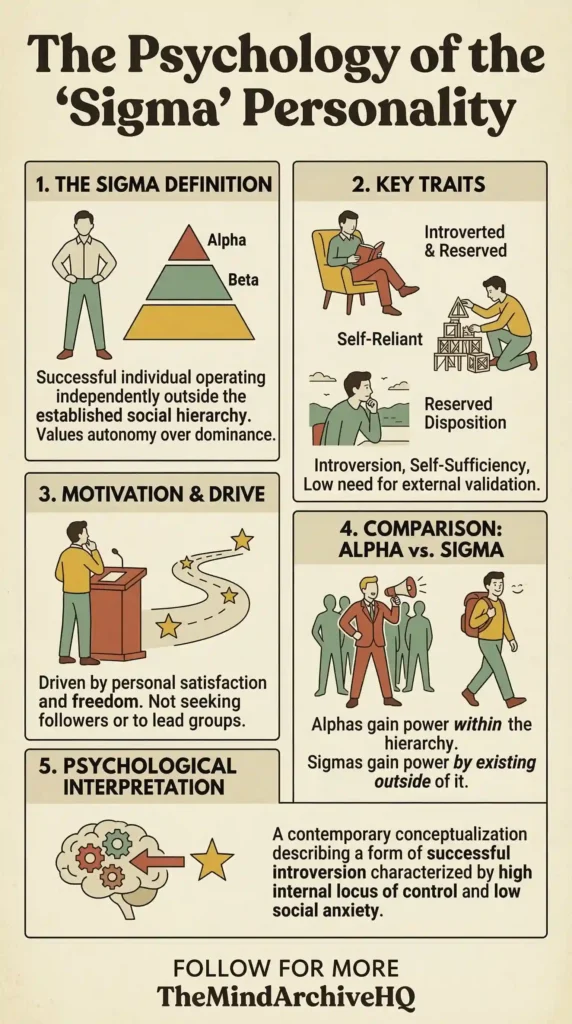
Defining the Sigma: The Rebel Without a Need for a Cause
In psychological terms, the Sigma personality aligns closely with highly independent, introverted individuals who score low on “Agreeableness” (in the sense of blind conformity) but high on “Conscientiousness” and “Openness” in the Big Five Personality Traits.
Unlike a rebel who fights the system just to prove a point, the Sigma simply ignores the system. They don’t hate society; they are just deeply indifferent to its arbitrary rules. Their self-worth is entirely decoupled from social status, designer labels, or corporate titles. If an Alpha builds a pyramid so they can stand at the top, the Sigma looks at the pyramid, shrugs, and walks into the forest to build their own cabin.
The Neuroscience of Intrinsic Motivation
To understand the Sigma, we have to look at how their brain processes rewards. Most humans are intensely social creatures. Our brains are hardwired to release dopamine—the “feel-good” neurotransmitter—when we receive social validation, praise, or group acceptance. This evolutionary trait kept our ancestors safe in tribes.
Sigmas, however, operate on a different neurological wavelength. They are driven by intrinsic motivation. Their dopamine hits come from mastering a skill, achieving a personal goal, or solving a complex problem in isolation. Because they do not require external validation to feel fulfilled, they are immune to the peer pressure, gossip, and social manipulation that control the majority of the population. This neuro-divergence makes them incredibly resilient and emotionally self-sufficient.
Alpha vs. Sigma: The Divide in Dominance
The easiest way to understand a Sigma is to compare them to an Alpha. Both are highly capable, intelligent, and successful, but their methods are polar opposites.
The Alpha relies on extroversion. They dominate through verbal communication, physical presence, and the management of a group. They need an audience to be an Alpha.
The Sigma relies on introverted competence. They lead by example, often working in the shadows. They are just as dominant, but their dominance is directed inward—mastering themselves rather than mastering others. If a Sigma is placed in a leadership role, they are usually reluctant leaders who empower others rather than micromanaging them.
The 5 Core Psychological Traits of a Sigma
If you are wondering whether you or someone you know fits this archetype, look for these foundational psychological traits:
Absolute Autonomy: They fiercely protect their freedom. They will often choose a harder, less lucrative path if it means they don’t have to answer to a boss or conform to a corporate culture.
Hyper-Observation: Tying into our previous research on silent people, Sigmas are masters of observation. Because they aren’t busy trying to impress the room, they quietly analyze the motives, insecurities, and body language of everyone around them.
Social Chameleonism: While they prefer solitude, Sigmas are not socially awkward. They possess high emotional intelligence and can blend into any social situation if required. They can be charming and engaging, but the moment the interaction is over, they retreat to recharge in solitude.
Comfort with Silence: They do not feel the need to fill quiet moments with small talk. A Sigma will only speak when they have something of high value to add to the conversation.
A Small, Impregnable Inner Circle: Sigmas do not have “squads” or large friend groups. They have two or three deeply vetted, intensely loyal connections. Once you are in their inner circle, they will protect you fiercely.
The “Dark Side” of the Lone Wolf
No personality type is without its flaws, and the Sigma is no exception. Because of their hyper-independence, Sigmas often struggle with vulnerable intimacy. Their psychological walls are built incredibly high, making it difficult for romantic partners to feel truly let in.
Furthermore, their refusal to play office politics or engage in networking can sometimes hinder their professional trajectory. They operate on the assumption that “my work will speak for itself,” which isn’t always true in highly corporate, socially-driven environments. Their biggest psychological hurdle is learning how to ask for help, as they view reliance on others as a fundamental weakness.
The Magnetic Pull: Why Are We So Attracted to Them?
There is a reason the Sigma archetype is romanticized in literature and film (think of characters like John Wick or James Bond). Human beings are naturally intrigued by what they cannot control or understand.
In a world where everyone is oversharing on social media and begging for attention, a person who remains silent, private, and unfazed by public opinion is a striking anomaly. Their detachment is deeply charismatic. The Sigma’s mysterious nature acts as a psychological magnet, drawing people in precisely because the Sigma is not trying to pull them.
Conclusion: The Power of Walking Away
The Sigma personality represents a fascinating evolution in human social dynamics. They remind us that success, happiness, and dominance do not always require a loud voice or a massive following. Sometimes, the most powerful thing a person can do is simply step outside the hierarchy, embrace the silence, and chart their own course.
If you are a Sigma, stop apologizing for your need for solitude. It is not a flaw; it is your ultimate psychological advantage.
Are you fascinated by the hidden mechanics of human behavior? Keep exploring the archives here at TheMindArchiveHQ as we continue to decode the mind, one psychological deep-dive at a time.