Introduction: The Misunderstood Mind It is 2:00 AM. The house is completely dark and silent, yet your mind feels like a bustling stock exchange floor. You are currently replaying a conversation you had three days ago, analyzing the exact tone of voice your coworker used. Simultaneously, you are predicting five different potential outcomes for a meeting next week, mapping out your responses for each scenario.
If you are a chronic overthinker, this nocturnal mental marathon is all too familiar. For years, pop psychology, self-help gurus, and well-meaning friends have told you that overthinking is a toxic habit. You are constantly instructed to “let it go,” “live in the moment,” and “stop stressing.” Overthinking has been aggressively pathologized as a flaw that needs to be cured.
But what if everyone is wrong? What if your racing mind is not a broken machine, but rather a high-performance engine operating exactly as it was designed to? Welcome to The Mind Archive HQ. Today, we are opening the files to reframe the narrative around the busy brain. We are going to explore the 6 hidden psychological powers of overthinkers and prove why your overactive mind is actually a profound cognitive advantage.
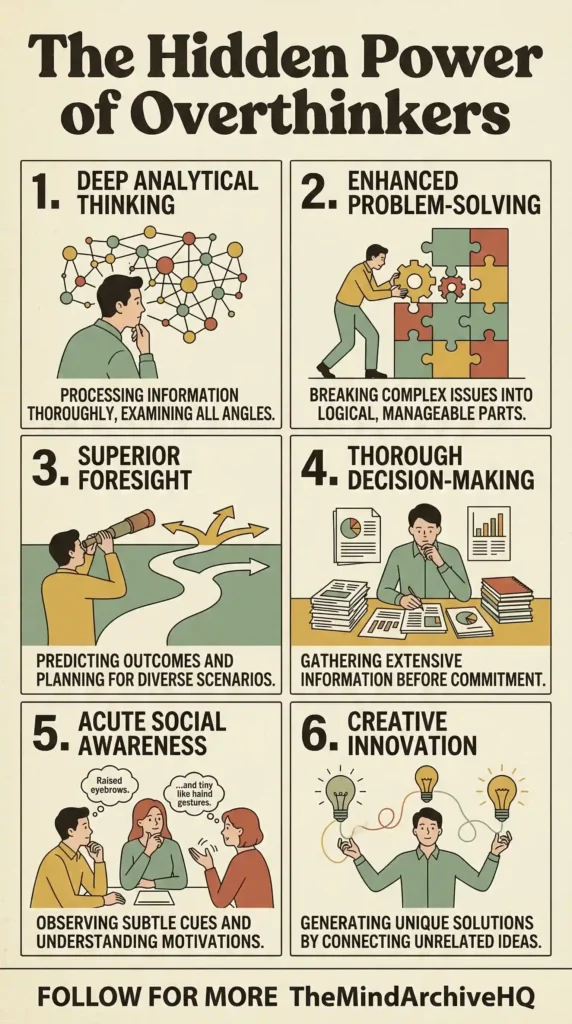
1. Deep Analytical Thinking: The Ultimate Information Processors
The average human brain is designed to conserve energy. It relies on mental shortcuts—known as heuristics—to make quick judgments and move on. The overthinker’s brain, however, rejects the shortcut.
When presented with a piece of information, an overthinker does not accept it at face value. They engage in deep analytical thinking, systematically processing the data, turning it over in their minds, and examining it from every conceivable angle. While others see a simple picture, the overthinker sees the pixels, the canvas, and the brushstrokes. This level of thorough processing means that when an overthinker finally arrives at a conclusion, it is rooted in deep structural understanding, not just surface-level assumption.
2. Enhanced Problem-Solving: Mastering the Complex
Overthinking is often unfairly equated with paralysis. People assume that because you are thinking so much, you aren’t doing anything. In reality, the overthinker is actively mapping the puzzle.
When faced with a massive, intimidating problem, a standard brain might feel overwhelmed and shut down. An overthinker’s brain instinctively begins breaking the complex issue down into logical, highly manageable parts. They mentally test out different solutions, discarding the ones that won’t work before even lifting a finger. By the time they take physical action, they have already solved the problem three times over in their head. They are the architects of the mental world, carefully drafting the blueprints before construction begins.
3. Superior Foresight: The Mental Time Travelers
Evolutionary psychology tells us that anxiety and rumination were essential survival tools for our ancient ancestors. The caveman who overthought the rustling in the bushes lived; the one who ignored it did not.
Today, this ancient survival mechanism manifests as superior foresight. Overthinkers are essentially mental time travelers. They possess the unique ability to project themselves into the future, predicting a wide array of outcomes and meticulously planning for diverse scenarios. If Plan A fails, they already have Plans B, C, and D lined up, complete with contingency protocols. This is not pointless worrying; it is high-level strategic preparation and risk mitigation.
4. Thorough Decision-Making: The Data Gatherers
In a culture that glorifies the impulsive, “go with your gut” style of leadership, the overthinker is often seen as slow. However, data-driven psychology heavily favors the overthinker’s approach.
Overthinkers are exceptional decision-makers because they refuse to commit prematurely. They are relentless data gatherers. They will research, compare, analyze historical precedent, and weigh the opportunity costs before making a final call. While their impulsive peers may move faster, they are also far more likely to make critical errors that require expensive corrections. The overthinker measures twice and cuts once, ensuring that their decisions are robust, logical, and built to withstand long-term scrutiny.
5. Acute Social Awareness: Reading the Unspoken
Because an overthinker’s brain is always running in the background, it picks up on the subtle frequencies of human behavior that others miss entirely.
This leads to a superpower known as acute social awareness. An overthinker does not just listen to the words being spoken; they are actively decoding the entire environment. They notice the raised eyebrow, the micro-tension in a smile, the subtle shift in posture, and the tiny, seemingly insignificant hand gestures. Because they analyze these cues, they can deeply understand people’s hidden motivations and emotional states. They can “read the room” the moment they walk into it, making them incredibly empathetic friends and formidable negotiators.
6. Creative Innovation: Connecting the Dots
Creativity is not magic; it is the neurological ability to connect completely unrelated ideas to form a new concept. Who is better at connecting seemingly random thoughts than someone whose brain is constantly jumping from one idea to the next?
Overthinking fuels creative innovation. Because the overthinker’s mind wanders through vast archives of memories, facts, and observations, it naturally begins to draw lines between dots that no one else sees. A standard mind walks in a straight line; an overthinker’s mind explores the entire maze. This highly active neural network is exactly what generates unique, out-of-the-box solutions and groundbreaking creative work.
Conclusion: Managing the Power
To be clear, chronic rumination can be exhausting. An engine that never powers down will eventually burn through its fuel. The goal is not to let your overthinking control you, but rather to learn how to harness it.
You must establish boundaries for your brain—giving it designated times to analyze and designated times to rest. But you must also stop viewing your cognitive depth as a disease. The next time someone tells you that you are “thinking too much,” just smile. You are simply preparing, analyzing, and innovating on a level they haven’t reached yet.
Are you fascinated by the hidden mechanics of human behavior and the power of the quiet mind? Keep exploring the archives here at TheMindArchiveHQ as we continue to decode the psychology of everyday life.