Introduction: The Emotional Sponge
Have you ever walked into a room where two people were just arguing? Even if they are perfectly silent and smiling when you enter, you can instantly feel the heavy, suffocating tension hanging in the air. While others might casually grab a drink and join the conversation, your nervous system immediately goes on high alert.
You aren’t a mind reader, nor are you experiencing a supernatural phenomenon. You are simply exhibiting the classic traits of a High-Level Empath.
Empathy is a standard human trait—it is the ability to understand and share the feelings of another. But being an Empath takes this psychological mechanism to an extreme level. Empaths do not just understand emotions; they absorb them. They act as emotional sponges, soaking up the joy, stress, anxiety, and pain of everyone around them.
Welcome to The Mind Archive HQ. Today, we are breaking down the 6 distinct psychological signs that you are a high-level empath, and exploring the fascinating neuroscience behind why your brain feels the world so deeply.
The Neuroscience of Empathy: The Mirror Neuron System
Before we dive into the signs, it is crucial to understand the science. In the 1990s, neuroscientists discovered “mirror neurons” in the brain. These neurons fire both when you perform an action and when you observe someone else performing that same action.
In a high-level empath, this mirror neuron system is hyper-reactive. When an empath sees someone crying, their brain doesn’t just register the visual cue of tears; their mirror neurons actively simulate the neurological experience of sadness. This is why being an empath is exhausting—your brain is constantly running simulations of other people’s emotional states.
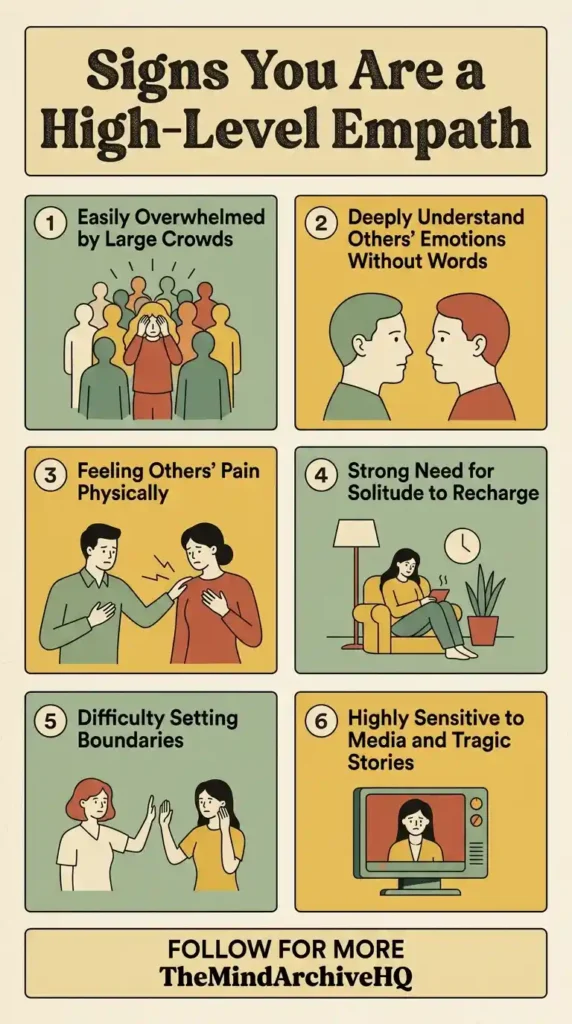
Sign 1: Easily Overwhelmed by Large Crowds
For an extrovert, a crowded concert or a bustling networking event is a source of energy. For an empath, it is a sensory minefield. Because an empath’s brain is constantly picking up on micro-expressions, body language, and emotional frequencies, a room of 100 people means 100 different emotional data points hitting their nervous system all at once.
This massive influx of stimuli leads to a rapid depletion of cognitive energy. It is not social anxiety that makes an empath want to leave a crowded room; it is severe psychological and sensory overload.
Sign 2: Deeply Understanding Others’ Emotions Without Words
A high-level empath rarely needs you to verbally articulate your feelings. They have a profound subconscious ability to “read the room.” This stems from an acute awareness of non-verbal communication. They notice the slight shift in your breathing, the fleeting shadow that crosses your eyes, and the micro-tension in your jaw.
Because of this, empaths are incredibly difficult to lie to. They will often feel a deep sense of cognitive dissonance when someone’s words do not match their underlying emotional state—such as someone claiming to be “fine” while radiating intense anxiety.
Sign 3: Feeling Others’ Pain Physically (Somatic Empathy)
This is perhaps the most bizarre and defining trait of a high-level empath. Also known as “Somatic Empathy” or “Mirror-Touch Synesthesia” in extreme cases, this occurs when an individual physically feels the pain or symptoms of someone else.
If a friend is talking about a severe stomachache or a heartbreak, an empath might genuinely begin to feel a phantom ache in their own stomach or a tightness in their chest. Their physical body is mirroring the psychological state of the person they are holding space for.
Sign 4: A Strong Need for Solitude to Recharge
Because an empath acts as a sponge, they eventually become saturated. The “Introvert Hangover” we have previously discussed in the archives is magnified tenfold for an empath.
To wring out the sponge and reset their nervous system, absolute solitude is not a luxury—it is a biological requirement. An empath requires a dark, quiet room where they are free from observing or processing any external emotions. Only in this total isolation can their cortisol levels drop back to a baseline state.
Sign 5: Difficulty Setting Boundaries
This is the dark side of the empath personality. Because an empath feels the pain of others as if it were their own, the idea of causing someone else disappointment or anger is agonizing. Saying “no” to a favor feels incredibly heavy because the empath instantly internalizes the other person’s potential negative reaction.
Consequently, high-level empaths often fall into the trap of people-pleasing. They become the “therapist friend,” constantly draining their own battery to keep others afloat, often attracting narcissistic personalities or “energy vampires” who exploit their boundless emotional generosity.
Sign 6: Highly Sensitive to Media and Tragic Stories
A high-level empath must carefully curate their media diet. Watching the evening news, listening to true crime podcasts, or viewing violent, emotionally devastating movies can trigger secondary traumatic stress. Their brain does not fully differentiate between a tragic story on a screen and a tragedy happening in their immediate environment. Consuming negative media can ruin an empath’s mood for days, leading to lingering anxiety and a profound sense of existential dread.
Conclusion: Building the Empath’s Shield
Being a high-level empath is often romanticized as a beautiful superpower, but without proper psychological boundaries, it can feel like a curse. If you identified with these 6 signs, the most critical step in your personal growth is learning to build an emotional shield.
You must learn the difference between observing an emotion and absorbing it. You can hold space for someone in pain without pulling their pain into your own chest. Guard your solitude fiercely, learn the power of the word “no,” and remember: you cannot heal the world if you are running on empty.
Are you fascinated by the hidden mechanics of the mind? Keep exploring the archives here at TheMindArchiveHQ as we continue to decode human behavior and the silent power of the psyche.