Introduction: The Myth of the Popularity Contest From the hallways of high school to the networking events of the corporate world, society bombards us with a singular message: the more friends you have, the happier and more successful you will be. We are conditioned to view a buzzing social calendar and a massive contact list as the ultimate indicators of a life well-lived.
But what if you prefer a quiet Friday night at home with a book over a crowded dinner party? What if your inner circle consists of just two people whom you trust with your life, while you maintain a polite, distant boundary with everyone else?
If this resonates with you, you aren’t antisocial, and you certainly aren’t broken. In fact, evolutionary psychology suggests you might simply be highly intelligent. Welcome to The Mind Archive HQ. Today, we are opening the files on the fascinating correlation between high IQ and a shrinking social circle, exploring why the smartest people in the room often choose to walk alone.
1. The Savannah Theory of Happiness
To understand the social habits of highly intelligent people, we must look at a groundbreaking concept in evolutionary psychology known as the “Savannah Theory of Happiness.” Coined by evolutionary psychologists Satoshi Kanazawa and Norman Li, this theory proposes that the situations that brought our ancient ancestors joy still impact our baseline happiness today.
For most humans, frequent social interaction with a tribe was essential for survival, leading to a natural desire for community. However, Kanazawa and Li’s research revealed a striking anomaly: highly intelligent individuals experience lower life satisfaction when they socialize more frequently with friends.
The theory suggests that intelligent people are better equipped to solve complex problems and adapt to modern environments without needing the constant support of a “tribe.” Because their brains are highly adaptable, they do not rely on the herd for survival or happiness. In fact, excessive socializing actually distracts them from their internal cognitive pursuits, causing a drop in their overall well-being.
2. The Intolerance for Small Talk
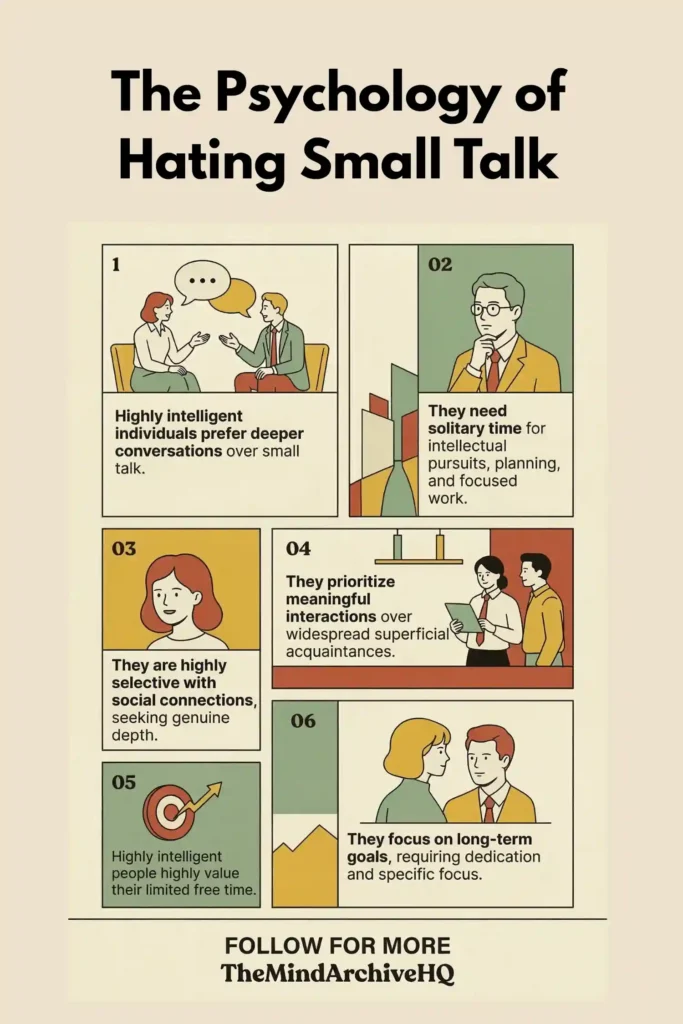
One of the most defining traits of a highly intelligent person is an absolute disdain for small talk. When forced to discuss the weather, celebrity gossip, or mundane daily routines, their brain literally feels under-stimulated.
Intelligent minds crave depth. They want to dissect ideas, debate philosophy, analyze human behavior, and explore the mysteries of the universe. Small talk is the psychological equivalent of feeding a high-performance sports car low-grade fuel; it simply causes the engine to stall. Because finding people who can engage in consistent, high-level intellectual discourse is rare, smart people naturally filter out superficial acquaintances. They would rather sit in complete silence than participate in a conversation that offers no mental stimulation.
3. The Ultimate Currency: Opportunity Cost
In economics, “opportunity cost” refers to the potential benefit lost when you choose one alternative over another. Highly intelligent people apply this economic principle directly to their social lives.
They view time as their most valuable and non-renewable currency. Spending three hours at a loud, crowded bar with people they barely know has a massive opportunity cost. That same three hours could have been spent reading a transformative book, working on a complex project, or simply recharging their mental batteries in peace. Because they highly value their limited free time, they ruthlessly cut out social obligations that do not yield a high return on investment in terms of joy, peace, or intellectual growth.
4. Depth Over Breadth in Relationships
It is a misconception that intelligent people do not value human connection. They actually value it so highly that they refuse to dilute it.
Instead of spreading their emotional energy thinly across fifty superficial acquaintances, they prefer to concentrate it deeply on a select few. They seek out friends who share their core values, who challenge them intellectually, and who respect their boundaries. Building this kind of profound connection takes time and immense emotional energy. By naturally limiting their social circle, they ensure that the friendships they do maintain are fiercely loyal, incredibly supportive, and genuinely authentic.
5. The Lone Wolf and Long-Term Goals
High intelligence is often coupled with high ambition and a strong sense of purpose. Highly intelligent people usually have complex, long-term goals that require intense focus, dedication, and long periods of uninterrupted “deep work.”
Socializing, by its very nature, introduces unpredictability and distraction. A person who is entirely consumed by writing a novel, building a business, or mastering a difficult skill simply does not have the bandwidth to manage the constant text messages, weekend plans, and emotional drama that often accompany a large friend group. Their shrinking social circle is not a sign of arrogance; it is a required sacrifice on the altar of their life’s work.
6. High Standards and the “BS” Radar
Finally, highly intelligent people possess a finely tuned psychological radar for authenticity. They are highly observant and can spot manipulation, fake personas, and hidden agendas from a mile away.
Because they can easily read the underlying motives of the people around them, they have zero tolerance for drama or toxic behavior. The moment they detect that a friendship is one-sided, draining, or built on a false premise, they will quietly and swiftly sever the tie. They prefer the peace of solitude over the chaos of bad company.
Conclusion: Guarding Your Peace
If your social circle is small enough to count on one hand, stop letting society make you feel inadequate. You are not missing out on the party; you have simply realized that the party was never that interesting to begin with.
Having fewer friends is not a social failure; it is a sign of psychological maturity. It means you have learned to value your time, protect your peace, and demand depth in a world obsessed with the superficial. Keep your circle small, keep your conversations deep, and never apologize for protecting your energy.
Are you fascinated by the hidden mechanics of human behavior and the power of the quiet mind? Keep exploring the archives here at TheMindArchiveHQ as we continue to decode the psychology of everyday life.