Introduction: The Aftermath of the Crowd
You just walked through your front door. The house is completely silent. You drop your keys, kick off your shoes, and sit on the edge of your bed, staring blankly at the wall. Your head aches slightly, your thoughts are foggy, and the mere idea of receiving a text message makes you want to throw your phone into the ocean.
You didn’t drink any alcohol tonight. You were just at a dinner party for three hours. So why do you feel like you were hit by a truck?
Welcome to The Mind Archive HQ. Today, we are opening the files on a phenomenon that millions of people experience but rarely understand: The Introvert Hangover. We will explore the deep neuroscience behind why socializing physically drains you, the hidden cost of “masking,” and the psychological protocol required to recharge your social battery.
Defining the Introvert Hangover
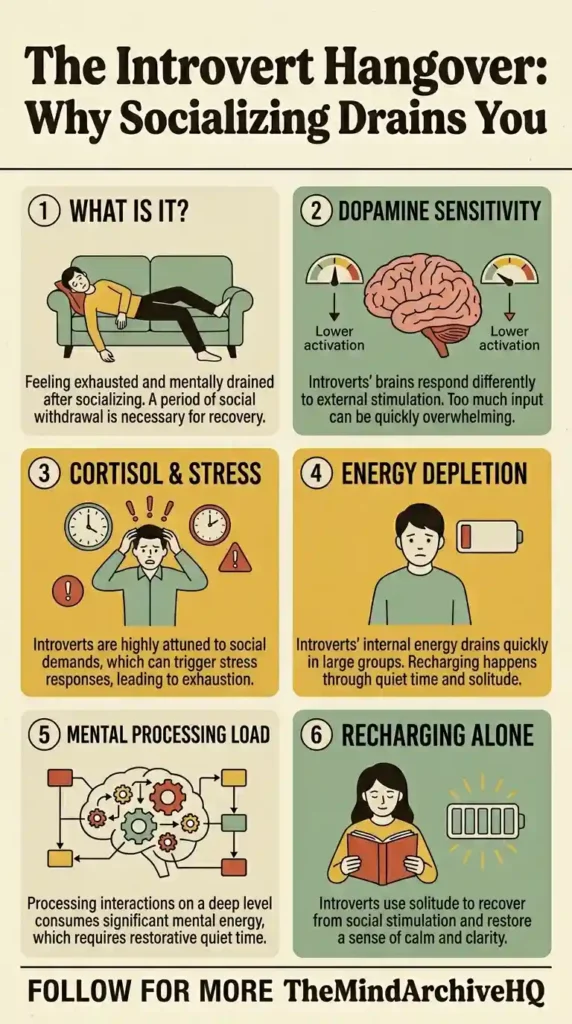
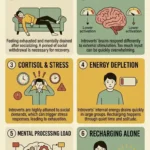
An “introvert hangover” is not a metaphor; it is a very real psychological and physiological state of extreme sensory overload. When an introvert pushes past their social limits, their nervous system becomes overwhelmed.
While an alcohol hangover is caused by dehydration and toxins, an introvert hangover is caused by cognitive depletion. Your brain has simply processed too much external data—too many voices, too many micro-expressions, too much background noise—and it initiates an emergency shutdown to protect itself. You become lethargic, irritable, and completely incapable of forming complex thoughts or engaging in further communication.
The Neuroscience of the Social Battery
To understand why this happens, we must look at the fundamental difference between an introverted brain and an extroverted brain. It all comes down to how we process rewards and stimulation.
Extroverts operate primarily on the dopamine pathway. Dopamine is a “feel-good” neurotransmitter that is triggered by external rewards, novelty, and social interaction. For an extrovert, a crowded, noisy room is a buffet of dopamine. It energizes them.
Introverts, however, operate predominantly on the acetylcholine pathway. Acetylcholine is a neurotransmitter linked to deep thought, focus, and internal reflection. Furthermore, blood flow in an introverted brain travels through a longer, more complex neural pathway. When an introvert is at a party, they aren’t just hearing words; their brain is simultaneously processing memories, analyzing body language, and predicting outcomes. Because their brains treat a casual conversation like a complex math problem, their cognitive energy reserves deplete rapidly.
The High Cost of “Social Masking”
One of the primary triggers of an introvert hangover is the act of “masking.” Masking is a psychological coping mechanism where an individual suppresses their natural traits to fit into social expectations.
Society rewards extroversion. We are taught to be loud, outgoing, and constantly enthusiastic. For an introvert, acting like an extrovert for several hours requires immense acting skills and massive amounts of cognitive energy. You are actively suppressing your natural urge to retreat while simultaneously forcing yourself to project high energy. This mental tug-of-war spikes cortisol (the stress hormone) levels in the body, leading to the physical exhaustion you feel once the “performance” is finally over.
The Physical Symptoms of Social Burnout
How do you know if you are experiencing an introvert hangover? The symptoms extend far beyond simply feeling sleepy. Common indicators include:
Brain Fog: An inability to concentrate, make decisions, or articulate thoughts clearly.
Physical Fatigue: A heavy feeling in your limbs, muscle tension, or even stress-induced headaches.
Intense Irritability: A sudden, sharp lack of patience for things that usually wouldn’t bother you.
Aversion to Stimuli: A desperate craving for a dark room, absolute silence, and zero physical touch. Even the sound of a TV or a bright light can feel physically painful.
The Energy Vampire Dynamic
Sometimes, an introvert hangover is triggered not by the amount of people, but by the type of people. Enter the “Energy Vampire.”
Energy vampires aren’t necessarily malicious people; they are often just highly extroverted individuals who require constant engagement, validation, or emotional labor from those around them. Because introverts are naturally exceptional listeners and highly empathetic, they become prime targets for people who want to talk endlessly about themselves. An hour spent with an energy vampire will drain an introvert faster than a five-hour party with close, low-maintenance friends.
The Cure: The Psychological Recharging Protocol
If you are currently suffering from an introvert hangover, you cannot just “power through it.” Pushing yourself further will only lead to a complete psychological burnout. Here is the protocol to recharge effectively:
Embrace Absolute Solitude: You cannot recharge if there is anyone else in the room. You need a space where you are not perceived by another human being. This removes the subconscious pressure to perform.
Low-Stimulation Activities: Doom-scrolling on social media does not help an introvert hangover; it actually introduces more data for your brain to process. Instead, engage in low-dopamine, low-stimulus activities: reading a book, staring out a window, or taking a silent walk in nature.
Communicate Your Boundaries: Do not ghost your friends, but be honest. Send a simple text: “I had a great time, but my social battery is completely dead today. I’m going to unplug and rest. I’ll catch up with you tomorrow.” * The Power of the “Irish Goodbye”: To prevent future hangovers, master the art of leaving early. You do not need to stay until the very end of an event. When you feel your battery hitting 15%, that is your cue to exit, quietly and without a massive farewell tour.
Conclusion: Guard Your Energy
An introvert hangover is your body’s alarm system. It is a biological demand for rest in a world that never stops talking. There is no shame in having a limited social battery. Your energy is a highly valuable currency—stop spending it on events and people that leave you bankrupt.
The next time you feel the hangover creeping in, don’t fight it. Retreat, rest, and let your mind find its quiet center once again.
Are you fascinated by the hidden mechanics of human behavior and the power of the quiet mind? Keep exploring the archives here at TheMindArchiveHQ as we continue to decode the psychology of everyday life.